

How to Learn Turkish: 6 Tips and Methods to Speak Turkish Fast
Lately, you might have been thinking about learning Turkish, but had no clear plan to do it in the simplest and fastest way possible. This article shares the most effective ways to learn Turkish online that I've learned over the last five years.
Before diving into the tips, note that it's a mistake to think you can't learn Turkish. I've met many foreigners speaking Turkish fluently — sometimes even better than natives!
Speaking Turkish (or any foreign language) is possible for any age group, and many language experts confirm this.
But to learn Turkish, you'll need some guidance, which is why I'm here.
Below are responses to the question how to learn Turkish fast. Focusing on these areas will help you learn Turkish in a few months. But first, let's answer a couple of simple questions about Turkish:
How Long Does It Take to Learn Turkish?
Of course, it depends on how motivated you are, what your native language is, how frequently you study, and more. However, there are studies that give an idea of how many hours it'd take to learn Turkish.
The FSI (Foreign Service Institute) of the US government has researched how many hours it takes for an English speaker to become fluent in a foreign language.
The research groups languages into five categories depending on how close they are to English. Turkish is in the fourth group, considered profoundly different from English.
Is Turkish Difficult to Learn for English Speakers?
For example, if an English speaker needs 1 hour of daily study to become fluent in Dutch (very similar to English), they'd need 2 hours of study for Turkish.
If you were to learn Korean or Arabic (in the fifth group), you'd need 4 hours of study for the same progress.
Don't let this intimidate you, because several things make learning easier for an English speaker:
- Turkish grammar is very regular and easy to learn — it has almost no exceptions or irregular verbs.
- Turkish doesn't have genders or articles.
- Turkish spelling is phonetic — you read each letter's sound as written (unlike French).
Many methods promise to teach foreign languages extremely fast without much effort. Unfortunately, learning a language isn't possible in your sleep, or in three weeks… you need to put in the effort to reach your goal.
"The longest way round is the shortest way home."
Instead of losing time on ineffective apps and techniques, it's best to join a Turkish class without wasting time and money. It's important to study grammar systematically and follow a curriculum prepared by professional linguists.
If you live in a big city, you can likely find a Turkish class near you. If not, or if you'd prefer online lessons, you can consider taking our courses online.
I can vouch for the quality of our classes, because we've received consistently positive feedback from our students. :)
1. Learn Turkish With Our Zoom Classes

As we adjusted to the 'new normal' of a pandemic, we started offering Turkish classes to our students.
We started to form classes of four students to ensure plenty of interaction and speaking time for each person. We couldn't believe how fun and practical these classes turned out to be!
Here's a couple of feedback from our students:
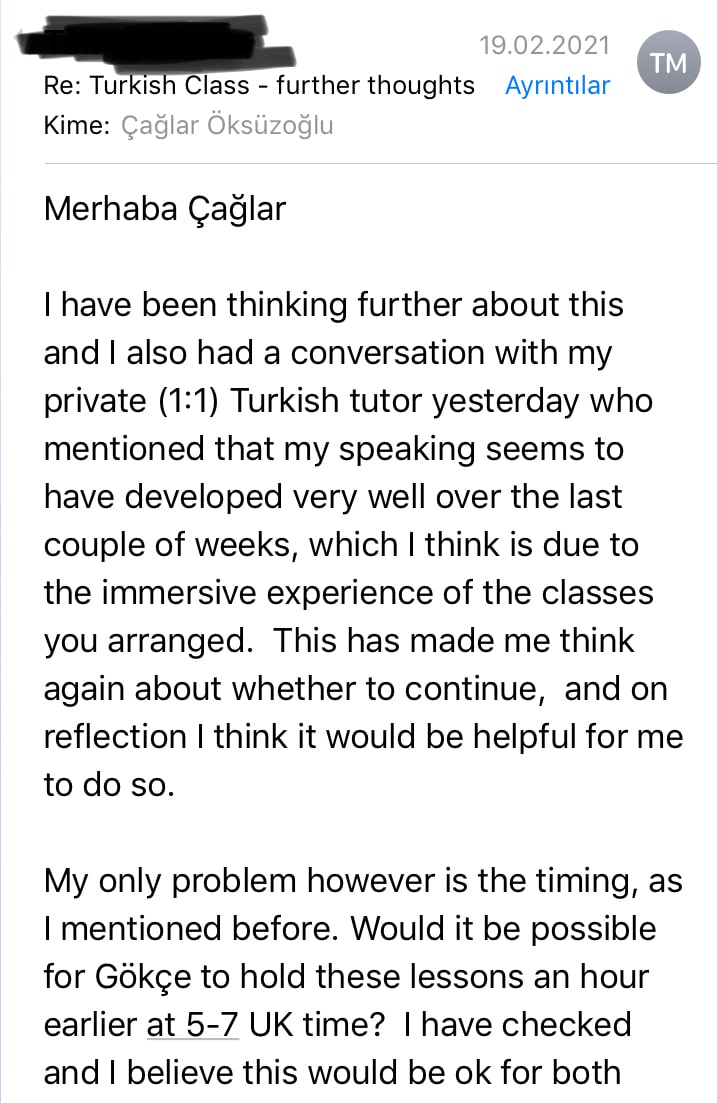
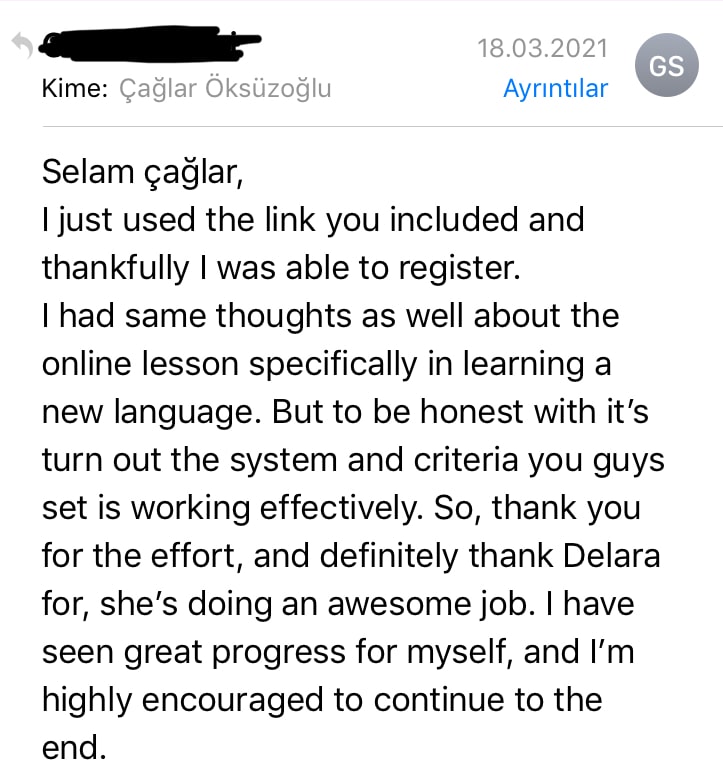
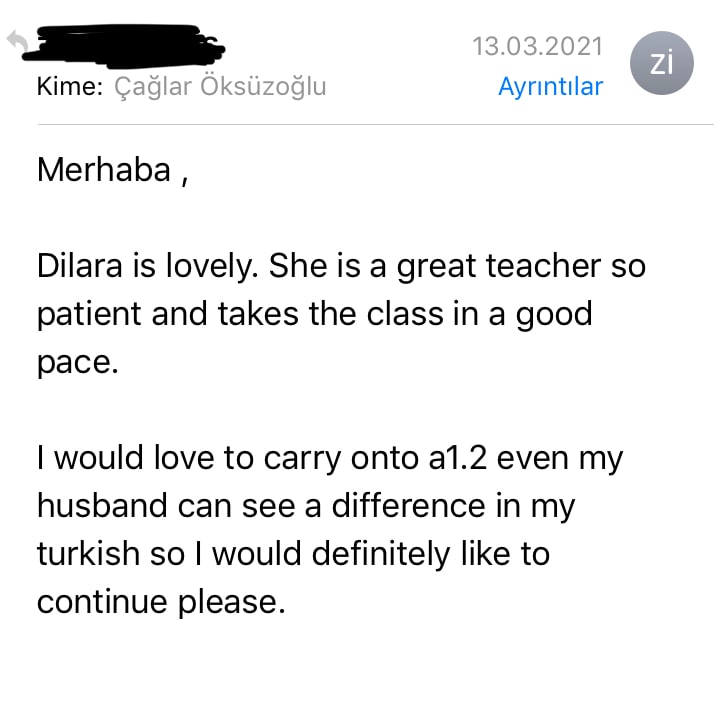
Almost all of our students continue their lessons with positive feedback, and many form new friendships along the way — which helps, since you learn faster alongside people you enjoy spending time with.
We believe language and interaction are essential to language learning. Our lessons are academic, focused on improving reading, writing, listening, and speaking skills.
You can find more information and class times on the Turkish classes page.
2. Study Turkish With a Native Tutor
Learning a new language takes time, so you may need extra effort and resources to make it work.
A personal tutor is one such resource. A native tutor will customize lessons for you and guide you through the learning process, making it more effective.
You can consult your tutor whenever something isn't clear. They'll give you ongoing feedback on your progress and how far you are from your goals.
Studying alone is a must, but you also need to expose yourself to the spoken language.
Learning alone with a textbook, without any professional guidance, can leave you speaking a version of the language that doesn't quite match how it's really spoken.
Be careful when choosing a tutor, though — many online platforms let you find one, but not all tutors have a professional background.
3. Make Turkish Part of Your Life and Find a Language Partner
Language immersion is one of the easiest ways to learn a new language.
It means exposing yourself to daily life situations where you have to speak Turkish. If that's not an option, you can expose yourself to Turkish through subtitles and translations.
Watching Turkish TV series with English subtitles will help you learn and understand Turkish more quickly, and there's plenty of Turkish TV out there! If you want to learn Turkish before visiting the country, this technique is especially useful.
You can also learn Turkish by learning Turkish culture — for instance, by practicing Turkish cooking. In turn, you'll pick up more vocabulary, especially the words used to prepare the dishes.
Changing your phone and computer language to Turkish helps too, though it only exposes you to what's actually on your phone — so changing your phone's language or watching Turkish series alone won't teach you Turkish by itself.
These things will help reinforce your learning, but they're not enough on their own.
Language learning is a matter of building a new habit. It requires studying regularly.
4. Listening Practice

Building your listening skills is crucial when learning a new language. It helps you understand what people are saying, gain fluency, and develop your ear for the language.
Watching Turkish TV programs is one way to build your listening skills, whether on TV or YouTube.
You can also listen to simplified stories or fairy tales for kids — it'll help your listening as well as your reading.
Lastly, consider taking Turkish online speaking classes, where you can build your listening skills by asking questions and hearing others' responses. Speaking classes build your listening and speaking skills at the same time.
Listening to a long text or other people talking is essential practice, so watching the news in Turkish — especially on topics you already know — can help a great deal.
Finding a topic you like and listening to Turkish content about it will make practice fun and effective! Look for audio about cars, flowers, or your favorite Turkish drama (whatever interests you). Listen to it again and again, and try to understand it!
5. Read Short Stories in Turkish

If you love reading, easy-to-read Turkish stories are exactly what you're looking for! Study resources can be hard to find and, often, boring to read. That's why we prepared a short story book with 9 appealing short stories written in simple Turkish.
The authors include Ömer Seyfettin, Halit Ziya Uşaklıgil, and Sadri Ertem. Each story is paired with a vocabulary section at the bottom of the page. Reading these stories helps you practice Turkish grammar and learn new words, while also enjoying real Turkish literature.
We recommend it for intermediate and advanced learners! View the reviews of the book here.
6. Get Happy When You Make Mistakes
Many people avoid speaking in order not to make mistakes.
Not being afraid of mistakes is essential if you want to speak Turkish, or any foreign language. The more you speak and make mistakes, the faster you learn — because when you make a mistake, you won't forget that moment, and next time you won't make the same mistake. So get happy when you make a mistake!
Find a language partner who can correct your mistakes — it'll speed up your learning. If you're trying to learn a new language, don't get demoralized when someone corrects you. You need the opposite mindset if you want to progress fast.
Take every chance to practice your speaking, without fear of failure — whether ordering your favorite juice, asking for directions, or shopping at a mall.
Always take corrections positively, and review what you've learned again and again until you can speak more confidently.