
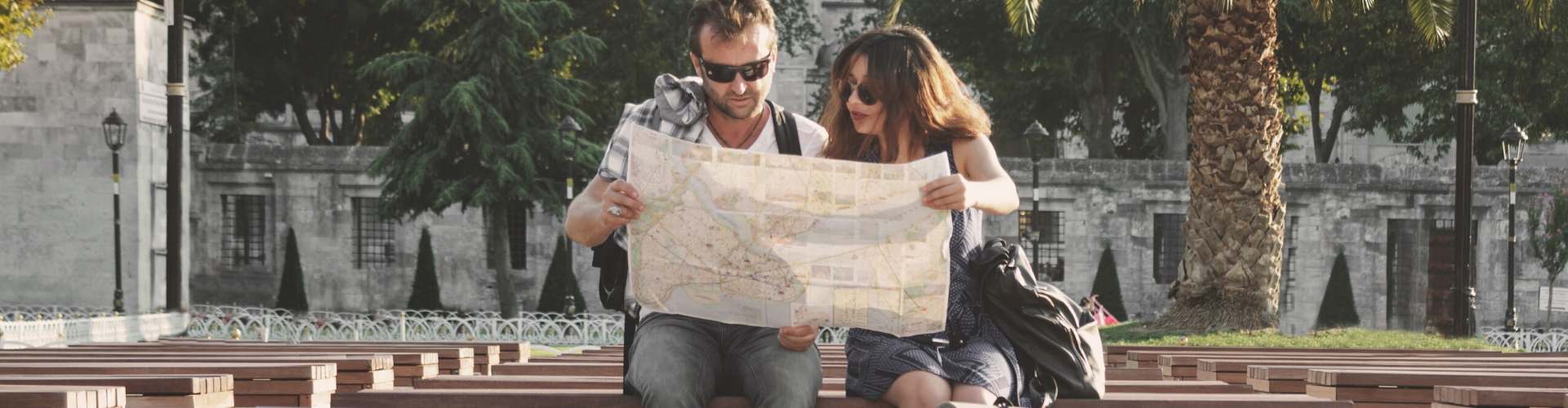
Asking for Directions in Turkish: Audio Dialogue + PDF
If you are not familiar with the city, it might be really difficult to find your way back home or hotel. But if you speak some Turkish and can ask help from a native, you’ll find out that they are happy to help you. In the dialogue, you’ll hear two people trying to find the most convenient route. At the end of the lesson, you’ll learn how to ask for directions and understand the instructions a Turkish speaker might give you back — street names, turns, distances or landmarks.
Essential Turkish Phrases for Asking Directions
The dialogue below will be covering how to get somewhere, how much it’d cost and which vehicle to choose. Here are some useful patterns to ask for any directions and instructions you might receive.
| Turkish | English |
| Affedersiniz, bir şey sorabilir miyim? | Excuse me, can I ask you something? |
| Taksim’e nasıl gidebilirim? | How can I get to Taksim? |
| Burası nerede? | Where am I? |
| Dümdüz gidin. | Go straight ahead. |
| Sağa dönün. | Turn right. |
| Sola dönün. | Turn left. |
| Karşıya geçin. | Cross to the other side. |
| Köşede. | On the corner. |
| Yanında. | Next to it. |
| Karşısında. | Across from it. |
| Ne kadar uzakta? | How far is it? |
| Yürüyerek gidebilir miyim? | Can I walk there? |
| Hangi otobüse binmeliyim? | Which bus should I take? |
| Nerede inmeliyim? | Where should I get off? |
Audio Dialogue
Now listen to a real conversation: a tourist near Taksim asking a local how to get there, and weighing metro against taxi.
Turkish Transcript
Turist: Burası yanlış sokak… Hmm, pardon, bir şey sorabilir miyim?
Yerli: Tabii, buyurun.
Turist: Ben Taksim’e gitmek istiyorum. Nasıl gidebilirim?
Yerli: Ah evet. Taksiyle mi? Metroyla mı? Otobüsle mi?
Turist: Bilmiyorum. Fark etmez.
Yerli: Peki… 100 metre ileride metro var. Metroyla çok hızlı gidebilirsiniz.
Turist: Ah, nerede bilet alabilirim?
Yerli: Metro istasyonunda makinelerden nakitle alabilirsiniz.
Turist: Bilet ne kadar?
Yerli: Bir şey değil… 2-3 lira.
Turist: Peki. Taksiyle daha hızlı, değil mi?
Yerli: Evet. Taksiyle daha hızlı ve daha rahat tabii. Ama trafik olabilir. Dikkat edin.
Turist: Taksiyle ne kadar?
Yerli: Zannediyorum 20-25 lira arası.
Turist: Tamam, teşekkür ederim. Taksiyle gitmek istiyorum. ATM nerede, biliyor musunuz?
Yerli: Maalesef bilmiyorum.
Turist: Peki, teşekkürler. İyi günler.
Yerli: İyi günler.
English Translation
Tourist: Sorry, this is the wrong street… excuse me, can I ask you something?
Local: Sure, go ahead.
Tourist: I want to go to Taksim. How can I get there?
Local: Ah, I see. By taxi? By metro? By bus?
Tourist: I don’t know. It doesn’t matter.
Local: Well… there’s a metro station 100 metres ahead. You can get there very quickly by metro.
Tourist: Oh, where can I buy a ticket?
Local: You can buy one with cash from the machines at the metro station.
Tourist: How much is the ticket?
Local: It’s very little — around two or three lira.
Tourist: Okay. It’s faster by taxi, isn’t it?
Local: Yes. Of course it’s faster and more comfortable by taxi. But there might be traffic. Watch out for that.
Tourist: How much would it be by taxi?
Local: I’d guess somewhere between twenty and twenty-five lira.
Tourist: Okay, thank you. I’ll go by taxi then. Do you know where the ATM is?
Local: Unfortunately, I don’t know.
Tourist: Alright, thanks. Have a good day.
Local: You too.
Note: this dialogue was recorded a while ago, and ticket and taxi fares in Istanbul have gone up since then — treat the numbers in the transcript as part of the story, not current pricing.
In practice, most Istanbul metro and bus fares today are paid with an Istanbulkart (a rechargeable transit card) rather than single-use cash tickets bought fresh each time — you can buy and top up a card with cash or bank card at machines in most stations.
How to Ask for Directions in Turkish
Start with a polite opener, then say where you want to go:
All three patterns work with almost any destination — you just attach the right suffix to the place name (more on that in the Grammar Notes below).
Understanding Turkish Directions
Turkish directions are usually a short sequence of instructions, not a single phrase. A typical answer sounds like this:
A few pieces worth listening for:
If you miss a step, it’s completely normal to ask them to repeat it: Tekrar edebilir misiniz? (Could you repeat that?)
Grammar Notes
-Abil: Ability, Permission, and Polite Requests
The suffix -Abil attaches to a verb stem to mean “can” or “may” — depending on context, it can express ability, permission, or possibility.
-lA for Transportation
Add -lA (with vowel harmony: -la or -le) to a vehicle to say “by”:
The Dative Suffix: Taksim’e
The dative suffix -A (-a/-e, written with an apostrophe after a proper noun like Taksim) marks the place you’re going to. It attaches to whatever destination you name: eve (to home), otele (to the hotel), oraya (to there).
Değil mi? (Tag Questions)
Unlike English, değil mi? never changes, no matter the subject or tense:
Location Words: İleride, Geride, Yanında, Karşısında
Vocabulary
Practice
You’re standing on a street corner in Istanbul, a little lost. Try saying these in Turkish before checking the essential-phrases table above:
1. Excuse me, can I ask you something?
2. How can I get to Taksim Square?
3. Is it within walking distance?
4. Which bus should I take?
Ready to Use This Out Loud?
You've read the transcript and grammar — now speak it. A short session with a native-speaking teacher turns passive listening into confident, natural speaking.