
Turkish Aorist: 4 Uses With Examples [STEP-BY-STEP]
Turkish aorist tense and present simple tense of English are roughly the same things. Many sources serve it as they are the same.
They have similarities but aorist is a totally different thing. Anyways, you’ll learn how to use aoist tense (properly) at the end of this section.
Okay, let’s talk about the Aorist a bit.
Aorist is a grammatical phenomena that you don’t see in every languages’ grammar. However, you can also see it in Ancient Greek. Turkish of aorist tense is Geniş Zaman which literally means ‘broad tense‘.
Aorist literally means indefinite or limitless in Greek language. (aóristos) Actually, you already know a word that has the same root of Aorist: Horizon. Horizon draws the boundary of earth and sky. Conversely, it means limited, definite.
But don’t hurry to think that Greek and Turkish aorist are the same things. In fact, the aorist of Greek has nothing to do with the Turkish aorist. You may have difficulties why they are called the same.
The aorist is one of those topics that's genuinely hard to figure out on your own — it has no clean equivalent in most languages. If you're thinking about working with a native speaker to build real intuition for it, I offer a free consultation where we can talk about what's tripping you up and figure out the right approach. No commitment — just a conversation.
What’s the function of Turkish aorist tense in the language?
It is used to describe continuing or habitual activities. (maybe you can relate being limitless, indefinite?)
So, next time when you see Aorist Tense, what should you understand?
Habitual things!
English present simple tense also has the same aspect. But Turkish aorist tense takes this a step further. Let’s see that with an example. (If you have studied Turkish present continuous tense -(I)yor, you’ll recognize the example.)
Yes, it’s literally ‘I am loving you’ but it means ‘I love you’. If we form it with Turkish simple present (as English does) it becomes: Seni severim.
But ‘seni severim’ doesn’t mean ‘I love you’ of English. Because ‘seni severim’ is this:
I love you Because I usually fall in love with the girls/boys like you. Because you are my type. It’s habitual.
I hope it is more clear now.
How to form Aorist tense:
Aorist Tense suffix is “-r”. So you add -(I)r or -(A)r to the verb stem.
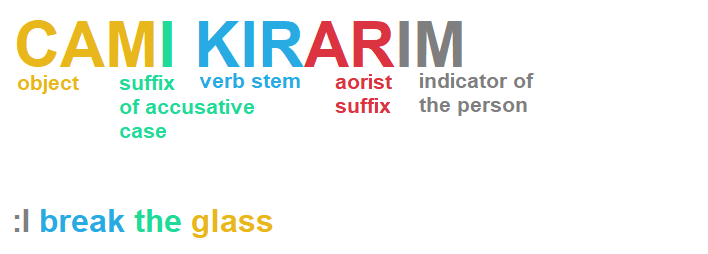
If verb stem ends with a vowel, then you simply add –r. But if the verb stem ends with a consonant then you are going to choose one of –(I)r or –(A)r. (Vowel harmony)
RULE 1: If the verb stem is only one syllable: -(A)r
RULE 2: If the verb stem is longer: -(I)r
SINGULAR
| Ben | Sen | O | |
| VERB+ | (i)rim | (i)rsin | (i)r |
| oku- | okurum | okursun | okur |
| kal- | kalırım | kalırsın | kalır |
| iç- | içerim | içersin | içer |
Since ‘O-ku’ is two syllable, you add (I)r.

Turkish Aorist Example
‘Fırçala-’ is the verb stem. (‘Fırça’ means ‘brush’ and ‘Fırçala’, to brush.) So, since the verb stem ends with a vowel, then you only add –r.
‘sev-‘ and ‘iç-‘ are one syllable stems. So, you add –(A)r.
Turkish Aorist Negative
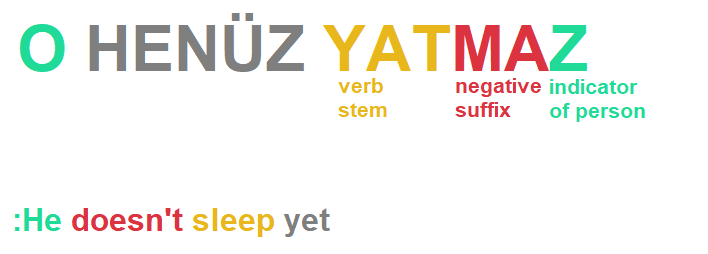
Negative aorist is formed differently. Negative suffix comes into the picture! –me.
NEGATIVE
| Ben | Sen | O | |
| VERB+ | mem | mezsin | mez |
| oku- | okumam | okumazsın | okumaz |
| kal- | kalmam | kalmazsın | kalmaz |
| iç- | içmem | içmezsin | içmez |
Turkish Aorist Negative Examples
PLURAL
| Biz | Siz | Onlar | |
| VERB+ | -(i)riz | -(i)rsiniz | -(i)rler |
| oku- | okuruz | okursunuz | okurlar |
| kal- | kalırız | kalırsınız | kalırlar |
| iç- | içeriz | içersiniz | içerler |
Turkish Aorist Tense Example
Şerbet: Şerbet is a west Asian drink that is made of different fruits. It is sweet and chilling to drink usually served in hot summer days. In Ottoman era, it was very common and today you could find it in the ‘old Istanbul city’, Fatih.
NEGATIVE
| Biz | Siz | Onlar | |
| VERB+ | -meyiz | -mezsiniz | -mezler |
| oku- | okumayız | okumazsınız | okumazlar |
| kal- | kalmayız | kalmazsınız | kalmazlar |
| iç- | içmeyiz | içmezsiniz | içmezler |
Turkish Aorist Example
Be Polite with the Aorist!
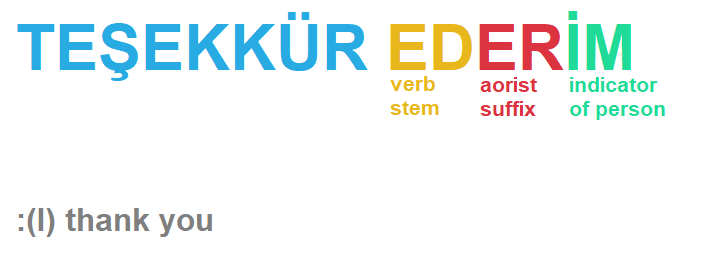
The aorist is also used when requesting something in a polite way.
For instance, “rica ederim” or “teşekkür ederim” are formed using aorist.
When narrating a story or describing an action happened in the past, the aorist is used.
Aorist Past Tense
Past of Aorist is translated as ‘used to’ in Turkish. The negative of it ‘mezdim’ is translated as I used not to or I would not. Let’s see the conjugations of aorist past tense together:
SINGULAR
| Ben | Sen | O | |
| VERB+ | -rdim | -rdin | -rdi |
| oku- | okurdum | okurdun | okurdu |
| kal- | kalırdım | kalırdın | kalırdı |
| iç- | içerdim | içerdin | içerdi |
Past Tense Example
Ben içerdim.
Sen içerdin.
O içerdi.
PLURAL
| Biz | Siz | Onlar | |
| VERB+ | -rdik | -rdiniz | -rdiler |
| oku- | okurduk | okurdunuz | okurdular |
| kal- | kalırdık | kalırdınız | kalırdılar |
| iç- | içerdik | içerdiniz | içerdiler |
Past Tense Example
Biz içerdik.
Siz içerdiniz.
Onlar içerdiler.
Kafaya takmak
lit. to attach, bother
to Care
Okay, let’s review again for which situations you must use the Turkish aorist tense. So that you reinforce your knowledge.
1.Habitual Things
2.Idioms and Proverbs
A Turkish proverb:
3.Polite requests
4.Future plans
To describe a future plan that is not planned, you use aorist. Let’s see with an example:
Interrogative of Aorist (Question Form of Aorist)
Okay, if it is clear so far: there is one thing left: QUESTION FORM!
The meaning in the question form of the aorist changes a little bit. It’s best translation into English is “would”.
Question form of Aorist (Interrogative of Aorist) is pretty simple and regular. Of course our “question suffix” m(I), comes into the picture: mı, mu, mü, mi
Choose one of them according to the vowel harmony and add to aorist! Don’t forget to write the question suffix separately!
But why do you have to write question suffix (mi) separately?
Think about it… (the answer is at the end)
Second one is the past aorist.
SINGULAR
| Ben | Sen | O | |
| VERB+ | -(ı)r mıyım? | -(ı)r mısın? | -(ı)r mı? |
| oku- | okur muyum? | okur musun? | okur mu? |
| kal- | kalır mıyım? | kalır mısın? | kalır mı? |
| iç- | içer miyim? | içer misin? | içer mi? |
Turkish Present Tense Example:
Ben içer miyim?
Sen içer misin?
O içer mi?
Here, you see a tiny irregularity for the third-person-plural. According to the pattern, it must be ‘(ı)r mılar‘ to be attached yet it is ‘(I)rlar mı?‘
PLURAL
| Biz | Siz | Onlar | |
| VERB+ | -(ı)r mıyız? | -(ı)r mısınız? | -(ı)r lar mı |
| oku- | okur muyuz? | okur musunuz? | okurlar mı? |
| kal- | kalır mıyız? | kalır mısınız? | kalırlar mı? |
| iç- | içer miyiz? | içer misiniz? | içerler mi? |
Turkish Present Tense Example:
Biz içer miyiz?
Siz içer misiniz?
Onlar içerler mi?
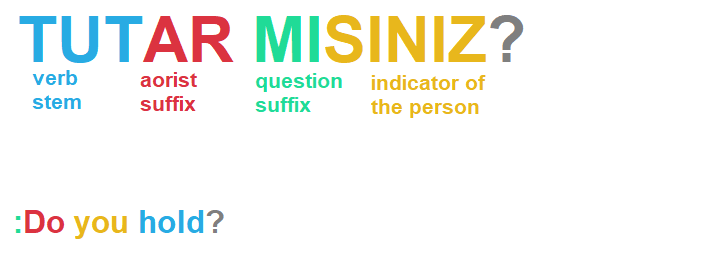
You see the interrogative of aorist in present tense. The past tense has a very similar pattern too. When you want to form interrogative of aorist in past, you’d simply add -di after the question suffix -mi.
Don’t forget that interrogative suffix (mi) is ALWAYS written separately. Okay, let’s come to the reason.
Why interrogative suffix -mi is written seperately in Turkish?
Because if it is written together, you could confuse the question suffix (mi) with the accusative form of possessive suffix.
How?
Of course, you can understand by the tonation but when you are reading written Turkish, it is confusing. Writing the question suffix separately is a good solution.
I hope it makes sense now.