
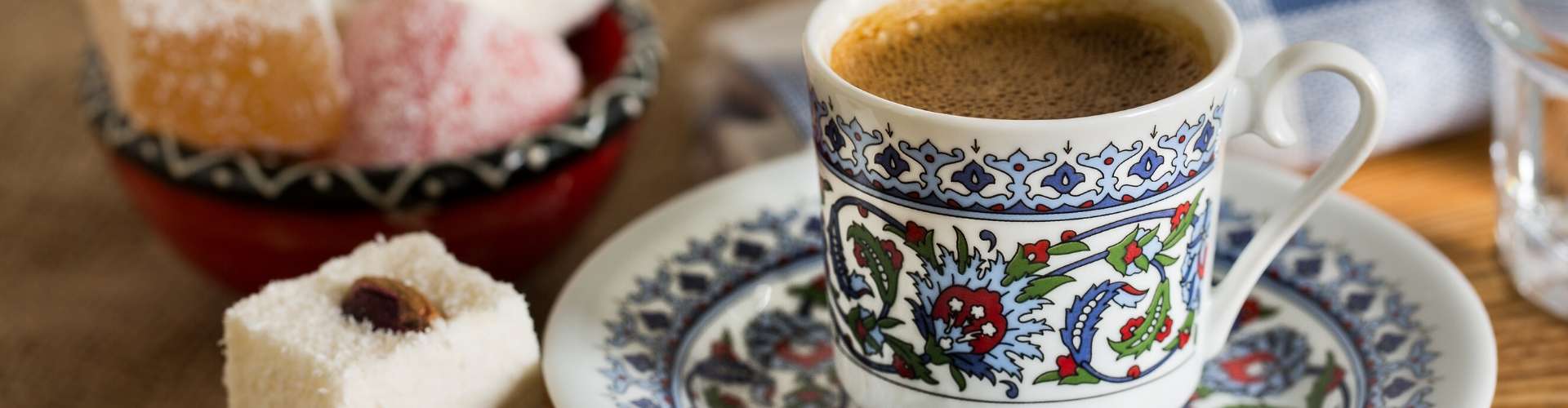
How to Order Coffee in Turkish: Dialogue with Audio
If you are one of those people who cannot wake up without coffee, learning how to order Turkish coffee is essential. Turks love drinking coffee. They call “kahvaltı” to breakfast which literally means “before coffee“. (Coffee is not much fun with an empty stomach) In the dialogue, you’ll hear someone ordering Turkish coffee so that you learn how to order yours.
Transcript
Garson: Türk kahvenizi nasıl alırsınız efendim?
Müşteri: Şekersiz.
Garson: Yiyecek bir şey ister misiniz?
Müşteri: Yanında lokum istiyorum. Bir de soğuk su lütfen.
Garson: Hemen…
…
Garson: Buyurun efendim.
Müşteri: Ama bu kahve şekerli. Ben şekersiz kahve istiyorum.
Garson: Nasıl olur? Kusura bakmayın efendim. Hemen şekersiz kahve getiriyorum.
Kız: Tamam, sorun değil, bekliyorum.
…
Garson: Buyurun şekersiz kahveniz.
Müşteri: Teşekkür ederim.
Garson: Bu da elmalı kurabiye.
Müşteri: Ama ben elmalı kurabiye istemiyorum.
Garson: Bu bizim ikramımız efendim. Afiyet olsun.
Müşteri: Gerek yoktu ama teşekkür ederim.
Translation
Waiter: How do you get your Turkish coffee, miss?
Customer: Without sugar.
Waiter: Would you like something to eat?
Customer: I want Turkish delight with the coffee. And cold water, please.
Waiter: I’ll bring it right away …
…
Waiter: Here you are, miss.
Customer: But this coffee has sugar. I want coffee without sugar.
Waiter: How come? Sorry, miss. I bring sugar-free coffee immediately.
Girl: Okay, no problem, I’m waiting.
…
Waiter: Here’s your sugar-free coffee.
Customer: Thank you.
Waiter: This is an apple cookie.
Customer: But I don’t want apple cookies.
Waiter: This is our treat. Bon Appetit.
Customer: No need… (You didn’t need to) but thank you.
Grammar Notes
Maybe the most useful structure in the dialogue is “istiyorum”. You can express whatever you want by using this structure.
There are many words having the suffix -lI that gives a sense of belonging. Also the suffix -sIz that gives the meaning of without. When you are attaching these suffixes, you have to consider vowel harmony rules that you have just covered in the previous lessons.
-lI can be one of: -li, -lı, -lü, -lu
Do you remember how to ask “Do you want?”.
İster misin? or İster misiniz? The question suffix here is –mi. For the third person singular, it turns into:
Suffixes coming after –mi indicate the personal pronoun. –mi also changes depending on the previous vowels. For example,
This time, it is mı because a is a back vowel and the close version of a is ı.
*The tense structures in the examples will be covered in detail. At the moment, you are learning the question suffix.
So, how to answer this question?:
–tu indicates past tense. Since the waiter already brought the apple cookies, it is more appropriate to use gerek yoktu.
“Kahvenizi nasıl alırsınız?” — is the question you’d receive if you want to order Turkish coffee. How do you get (want) your coffee? The answers to this question are:
You are supposed to add sugar while you are preparing your Turkish coffee. For that reason, the amount of sugar you want is important. You never add sugar after the coffee is prepared.
Vocabulary
Ready to Use This Out Loud?
You've read the transcript and grammar — now speak it. A short session with a native-speaking teacher turns passive listening into confident, natural speaking.