
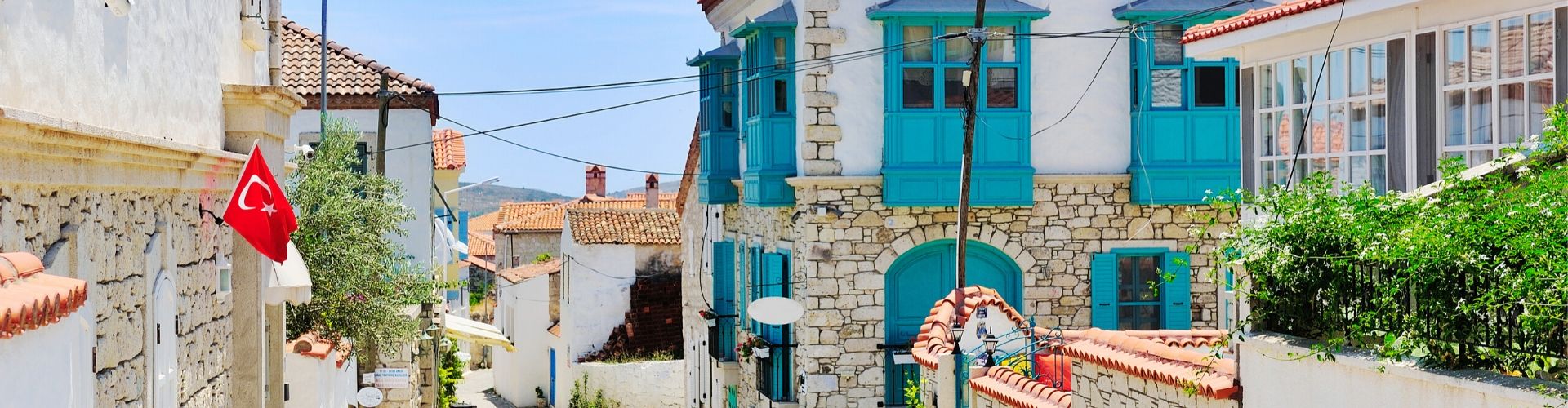
Turkish Hotel Phrases: Check-In Dialogue with Audio + PDF
Having a basic conversation with the hotel receptionist, expressing what do you want and asking simple questions can help you a lot during your vacation. In the dialogue, you’ll hear a conversation between a receptionist and a guest. At the end, you’ll be able to answer possible questions about yourself and your staying, confirm your reservation and ask practical questions about breakfast, Wi-Fi, or your room.
Essential Hotel Phrases in Turkish
This list cover confirming your reservation, checking in, and the questions you’ll most often need at the receptionist.
| Turkish | English |
| Rezervasyonum var. | I have a reservation. |
| [İsim] adına rezervasyonum var. | I have a reservation under the name [Name]. |
| Giriş yapmak istiyorum. | I’d like to check in. |
| Rezervasyon numaram burada. | My reservation number is here. |
| Pasaportumu göstereyim mi? | Should I show my passport? |
| Kahvaltı saat kaçta? | What time is breakfast? |
| Wi-Fi şifresi nedir? | What’s the Wi-Fi password? |
| Oda numaram kaç? | What’s my room number? |
| Oda anahtarını alabilir miyim? | Can I have the room key? |
| Yardımcı olabilir misiniz? | Could you help me? |
| Odada bir sorun var. | There’s a problem with the room. |
| Çıkış saat kaçta? | What time is check-out? |
| Bagajımı burada bırakabilir miyim? | Can I leave my luggage here? |
| Yakınlarda güzel bir restoran var mı? | Is there a nice restaurant nearby? |
Hotel Check-In Dialogue with Audio
Now listen to a full Turkish hotel check-in dialogue: a guest confirming her reservation, checking in, and then asking the receptionist for local recommendations. The recording picks up mid-conversation, just after the guest has already asked to check in and given her name.
Turkish Transcript
Resepsiyonist: Tabii, hemen bakıyorum. Ayşe Şenlik. Böyle bir isim bulamadım. Bu isimle rezervasyon yaptırdığınıza emin misiniz?
Ayşe: Ahmet Şenlik’i deneyelim bir de. Eşimin ismiyle yaptırmış olabilirim.
Resepsiyonist: Hemen bakıyorum. Bu isimle de herhangi bir kayıt çıkmadı. Rezervasyon numaranız var mı, Ayşe Hanım?
Ayşe: Ah. Evet. Telefonumda olmalıydı. Böyle bir durumun olma ihtimaline karşı fotoğraf çektim. Ah! İşte burada. Rezervasyon numarasını söylememi ister misiniz?
Resepsiyonist: Evet, lütfen, alayım.
Ayşe: 461290.
Resepsiyonist: Hah, şimdi çıktı. Kusura bakmayın, bazen böyle sistemsel arızalarla karşılaşabiliyoruz. 6 gecelik rezervasyonunuz var, doğru mudur efendim?
Ayşe: Evet.
Resepsiyonist: Ödemeyi yapmış görünüyorsunuz. Ben giriş yaptığınızı belirtiyorum. Arkadaşım sizi odanıza kadar çıkaracak. Oda numaranız 231. Deniz manzaralı en iyi oda diyebilirim. Eğer bir ihtiyacınız olursa, telefonda 0 tuşuna basarak resepsiyona ulaşabilirsiniz. Keyifli tatiller dilerim.
Ayşe: Çok teşekkür ederim.
…
Ayşe: Merhaba. Otel çevresinde yemek yiyebileceğimiz güzel bir restoran var mı?
Resepsiyonist: Tabii, efendim. Sahil şeridinde çok güzel balık lokantaları var. Eğer balık yemek istemiyorsanız, kültür merkezinin hemen yanında başka bir restoran var.
Ayşe: Balık lokantaları daha cazip göründü, teşekkür ederim. Peki, kent müzesine nasıl gidebiliriz?
Resepsiyonist: Ah, kent müzesine gitmek için tramvaya binmelisiniz. İki durak sonra indiğiniz zaman kent müzesi direkt karşınıza çıkacak.
Ayşe: Peki, ulaşım kartını nerede bulabiliriz?
Resepsiyonist: Tramvay duraklarında bilet makinesinden alabilirsiniz, efendim.
Ayşe: Peki, çok teşekkür ederim.
Resepsiyonist: Ben teşekkür ederim.
English Translation
Receptionist: Of course, let me check right away. Ayşe Şenlik… I can’t find a reservation under that name. Are you sure you booked under this name?
Ayşe: Let’s try Ahmet Şenlik as well. I may have made it under my spouse’s name.
Receptionist: Let me check. There’s no record under that name either. Do you have a reservation number, Ms. Ayşe?
Ayşe: Oh, right. It should be on my phone. I took a photo in case something like this happened. Ah, here it is! Would you like the reservation number?
Receptionist: Yes, please, go ahead.
Ayşe: 461290.
Receptionist: Ah, there it is now. Sorry — sometimes we experience system errors like this. You have a 6-night reservation, is that correct?
Ayşe: Yes.
Receptionist: Our records show that you have already paid. I’ll check you in now. A member of staff will show you to your room. Your room number is 231 — I’d say it’s the best room with a sea view. If you need anything, you can reach reception by pressing 0 on the phone. I wish you a pleasant holiday.
Ayşe: Thank you so much.
…
Ayşe: Hello. Is there a nice restaurant around the hotel where we could eat?
Receptionist: Of course. There are some lovely fish restaurants along the seafront. If you don’t feel like fish, there’s another restaurant right next to the cultural center.
Ayşe: The fish restaurants sound more appealing, thank you. So, how can we get to the city museum?
Receptionist: Ah, to get to the city museum you should take the tram. The museum will be directly in front of you when you get off two stops later.
Ayşe: Where can we buy a public transport card?
Receptionist: You can get one from the ticket machine at the tram stops.
Ayşe: Great, thank you so much.
Receptionist: My pleasure.
Grammar Notes
A few lines in the dialogue are said the way people actually talk in the moment — which isn’t always the clearest model to copy. Here are more natural or more standard versions of some of them:
| In the dialogue | More natural / standard |
| Eşimin ismiyle yaptırmış olabilirim. | Eşimin adına yaptırmış olabilirim. |
| Fotoğraf çektim. (as a phone confirmation) | Ekran görüntüsü aldım. |
| sistemsel arızalarla karşılaşabiliyoruz | sistem hatalarıyla / teknik sorunlarla karşılaşabiliyoruz |
| Ben giriş yaptığınızı belirtiyorum. | Giriş işleminizi yapıyorum. |
| Ulaşım kartını nerede bulabiliriz? | Ulaşım kartını nereden alabiliriz? |
Rezervasyon Yapmak vs. Rezervasyon Yaptırmak
Turkish often prefers the causative yaptırmak here, since you rarely book directly with the hotel yourself — a booking site or an app usually does it for you.
-DIğIndAn emin olmak
Emin olmak (“to be sure”) normally takes its object in the ablative case (-DAn), not the dative — so the standard pattern is -DIğIndAn emin olmak, not -DIğInA emin olmak.
You’ll sometimes hear the dative form in casual speech — the receptionist actually says “rezervasyon yaptırdığınıza emin misiniz?” in the dialogue above — but the ablative form is the one to use in careful speech and writing.
… ihtimaline karşı
-lA karşılaşmak
Karşılaşmak (“to encounter, to run into”) takes its object with -lA (“with”).
… doğru mudur?
… doğru mudur? turns a statement into a formal, polite confirmation question — roughly “is that correct?” It’s more formal than tagging a sentence with değil mi?
-mIş görünmek
-mIş görünmek means “to appear to have done/be something” — it reports how a situation looks based on the evidence at hand.
The Suffix “-ArAk”
-ArAk describes how an action is done, similar to “by …-ing” in English.
-(y)AbileceK + Noun
The future participle -(y)AbileceK can modify a noun directly, meaning roughly “that [subject] will be able to …”
-A binmek
Binmek (“to get on, to board”) takes its object in the dative case (-A).
Uçak + a → Uçağa (the k softens to ğ when the dative suffix -A is attached).
Vocabulary
Practice
Fill in each blank, then check your answers against the grammar notes above.
1. Ahmet Şenlik … rezervasyonum var. (under the name of …)
2. Rezervasyon yaptırdığınızdan … musunuz? (to be sure)
3. Yağmur yağma … şemsiye aldım. (in case of …)
4. Ödemeyi yapmış …. (to appear / seem)
5. Telefonda 0 tuşuna basarak resepsiyona …. (to reach)
6. Kent müzesine gitmek için tramvaya …. (to board)
Ready to Use This Out Loud?
You've read the transcript and grammar — now speak it. A short session with a native-speaking teacher turns passive listening into confident, natural speaking.